.png)
Why Swedish Massage Foundations Matter Before Advanced Techniques

A student recently asked me a fair question: “Is this school Swedish focused?”
The honest answer was yes, a large part of the curriculum does focus on Swedish massage. Not because Swedish massage is the only thing worth learning. Not because advanced work does not matter. It is because Swedish massage gives students the foundation they need before they try to do more complex work.
My short answer is that about one third of the hands on hours are focused on Swedish Massage Techniques. One third on introducing you advanced modalites that help fill your tool belt and one third on deeper therapeutics work.
In massage training, Swedish technique is like learning how to read before studying chemistry. You learn sounds, then syllables, then words, then sentences, then paragraphs. Later, when the subject gets difficult, like chemistry, your teacher expects that you already understand the language on the page.
Could someone teach chemistry using only pictures? Maybe. But it would be much harder.
Advanced massage is similar. Deep tissue, clinical work, specific stretching, sports massage, myofascial approaches, and other advanced techniques all assume that the student already understands touch, pacing, draping, body mechanics, flow, and how to communicate through their hands.
That is why Swedish massage foundations matter so much. They teach the language of massage.

Swedish massage is not just a beginner technique
Some people hear “Swedish massage” and think it means simple, light, or basic. That misses the point.
Swedish massage includes core skills that every massage therapist needs, such as:
Gliding strokes
Kneading
Friction
Percussion
Vibration
Transitions between strokes
Appropriate pressure
Client positioning
Draping
Session flow
Therapist body mechanics
Those skills may look simple from the outside. They are not simple when they are done well.
A good Swedish session requires rhythm, timing, awareness, and control. The therapist has to know where their weight is, how their hands contact the body, how to move from one area to another, and how to keep the session feeling connected instead of choppy.
That is the foundation.
A student who cannot control a basic effleurage stroke will struggle with advanced forearm work. A student who loses their posture during light kneading will likely have a harder time with sustained pressure. A student who does not understand flow may make even technically correct advanced work feel scattered.
Advanced technique does not replace Swedish training. It grows out of it.
Students need to walk before they run
Every skill based profession has a starting point.
A musician practices scales. A cook learns knife skills. An athlete learns footwork. A writer learns sentence structure. None of those basics are the final goal, but they support everything that comes later.
Massage is no different.
It can be tempting for students to want to skip ahead. Advanced work sounds exciting. It may feel more specialized. It may seem closer to the type of massage they eventually want to offer.
The problem is that advanced techniques demand more from the therapist, not less.
They require better body awareness, clearer intention, and a stronger understanding of tissue response. The therapist must know how to apply pressure without forcing it. They must know how to slow down without losing connection. They must know how to listen with their hands.
Those habits begin in Swedish massage.
The goal is not to keep students at the beginner level. The goal is to build the kind of foundation that lets them grow safely and skillfully.
When students learn to walk first, they do not limit themselves. They prepare themselves to run with better balance.
Swedish massage teaches the language of touch
The chemistry analogy works because chemistry is not only about facts. It has a language.
Before someone can understand chemical formulas, reactions, or equations, they need to read. They need to recognize symbols. They need to understand instructions. They need to follow the structure of a problem.
Massage has a language too.
That language includes:
How pressure feels under the hand
How muscles respond to different speeds
How to enter and leave tissue gradually
How to move around joints with care
How to keep one hand connected while the other changes position
How to sense when the client’s body is bracing
How to adjust without interrupting the session
Swedish massage gives students a place to learn that language clearly.
Without it, advanced technique becomes a set of movements copied from an instructor. The student might know where to put an elbow or how to use a forearm, but they may not understand why, when, or how much.
That is the difference between imitation and skill.
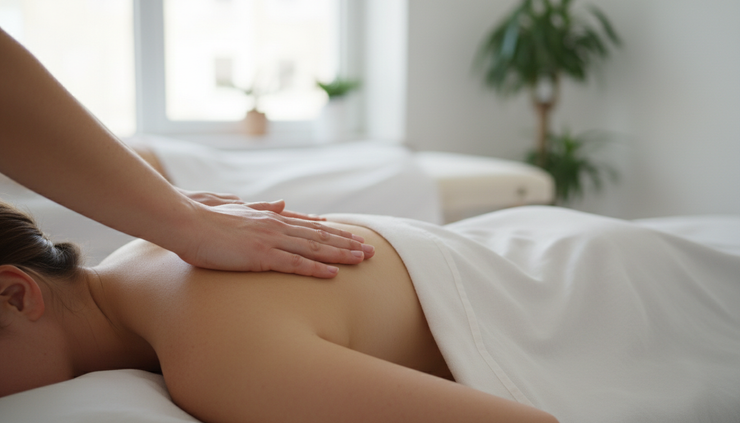
Body mechanics start with the basics
Body mechanics cannot be an afterthought in massage training. A therapist’s hands are only part of the work. The whole body is involved.
Good body mechanics include:
Using body weight instead of pushing from the hands
Keeping shoulders relaxed
Moving from the legs and hips
Maintaining a comfortable stance
Adjusting table height when needed
Staying close enough to work without reaching
Breathing while applying pressure
Swedish massage gives students repeated chances to practice these habits.
A long gliding stroke teaches the student how to shift weight. Kneading teaches rhythm and hand softness. Transitions teach foot placement. Working around the client teaches table awareness. Draping teaches respect, boundaries, and precision.
These are not side lessons. They are central to becoming a massage therapist.
If a student jumps into advanced work too soon, they may try to create power from the wrong place. They may press with their thumbs, lock their wrists, tense their shoulders, or lean awkwardly. Over time, those habits can make the work harder on the therapist’s body.
A strong Swedish foundation helps prevent that pattern. It teaches students how to work with their body instead of against it.
Flow matters more than students first realize
New students often focus on individual techniques. They want to know the stroke, the direction, the pressure, and the exact hand position.
Those details matter. But a massage session is more than a list of techniques.
A session needs flow.
Flow is what makes the work feel organized. It helps the client settle. It helps the therapist move with purpose. It connects one technique to the next so the session feels whole, not like separate pieces placed side by side.
Swedish massage is one of the best places to learn flow because the strokes naturally connect. A therapist can move from broad warming strokes into kneading, then into more specific work, then back out into broader contact. That pattern teaches pacing.
It also teaches restraint.
Advanced work can become too intense or too focused when students do not know how to enter and exit it well. A therapist may find a tight area and stay there without preparing the tissue or integrating it back into the whole session.
Swedish training teaches students how to zoom in and zoom out.
A helpful way to think about it is this:
Swedish foundation
Advanced technique
Builds rhythm, contact, pressure control, and full-session flow
Uses those skills for more specific goals and more complex applications
One supports the other. They are not in competition.
Advanced techniques assume Swedish skills are already there
Many advanced classes move quickly. They often focus on specific applications, such as working with certain muscle groups, using forearms, adding stretching, or addressing common patterns.
Those classes usually assume the student already knows the basics.
The instructor may not stop to reteach how to drape the leg, how to shift body weight, how to maintain contact, or how to connect one side of the body to the other. The advanced lesson begins where the foundation ends.
That is exactly why the foundation has to be strong.
If Swedish skills are weak, the student has to learn two things at once:
The advanced technique itself
The basic massage skills that should already support it
That can make learning stressful. It can also create confusion. The student may think the advanced technique is hard, when the real issue is that the underlying skills are not steady yet.
It is like trying to solve a chemistry equation while still sounding out the words in the textbook.
The student might get there, but the process is slower, harder, and less clear.

A foundation does not mean staying basic forever
A school that teaches a lot of Swedish massage is not saying students should only do Swedish massage after graduation.
A strong curriculum should help students build from general skills into more specific ones. Swedish massage gives them a base. Then they can add other tools with more confidence.
That growth might include:
Deeper pressure techniques
More detailed muscle work
Sports massage concepts
Gentle stretching
Chair massage
Prenatal adaptations, where appropriate training is included
Work with different client preferences and session goals
The order matters.
When students understand Swedish massage first, advanced work becomes more than a trick or routine. It becomes a choice. The therapist can ask, “What does this client need right now?” and then choose the technique that fits.
That is different from simply collecting techniques.
Massage education should not be about piling more and more moves onto a student. It should be about helping the student know when and how to use each tool.
Swedish massage teaches professional judgment
Technique is only one part of massage training. Students also need judgment.
They need to learn how to make choices during a session. They need to notice when a client relaxes, when they tense, when pressure should change, and when a simpler approach is better.
Swedish massage gives students room to practice that judgment without overcomplicating the session.
For example, a student may learn that slower work often feels more calming than fast work. They may notice that broad contact before specific pressure can help the client settle. They may learn that more pressure is not always more effective. They may begin to understand that good massage is not about forcing change.
This kind of judgment takes repetition.
It is not learned in one demonstration. It develops through practice, feedback, and reflection. Swedish massage offers that practice in a structured way.
The foundation helps protect the client experience
Clients may not know the names of techniques. They may not know whether the therapist is using effleurage, petrissage, friction, or forearm work.
They do notice how the session feels.
They notice if the therapist seems rushed. They notice if pressure comes on too suddenly. They notice if the therapist breaks contact often. They notice if the session feels disconnected.
Swedish massage training helps students create a better client experience because it teaches the basics clients can feel right away:
Smooth transitions
Clear contact
Respectful draping
Consistent pacing
Comfortable pressure changes
A sense of calm and organization
Advanced work should not take those things away. It should fit inside them.
A therapist can do very specific work and still keep the session grounded. That skill comes from having a foundation.
The best advanced work still has Swedish roots
Watch an experienced massage therapist work and you may see advanced techniques, but you will also see the basics underneath.
You will see weight shift. You will see rhythm. You will see broad contact. You will see smooth transitions. You will see the therapist prepare the area before doing more specific work. You will see them integrate that work back into the session.
That is Swedish foundation showing up, even when the session is no longer a classic Swedish massage.
The foundation does not disappear. It becomes part of the therapist’s style.
That is the real purpose of teaching Swedish massage early and often. It gives students a reliable structure they can build on for years.

A strong start makes advanced learning easier
When a student asks whether a school is Swedish focused, the deeper question may be, “Will I learn more than relaxation massage?”
The answer should be yes. A solid Swedish foundation is not the opposite of advanced education. It is the path toward it.
Students need time to learn the language of massage before they are expected to speak it fluently. They need to understand body mechanics before adding more pressure. They need to feel flow before breaking the session into specific goals. They need to build confidence with the basics before asking their hands, arms, posture, and attention to manage more complex work.
Swedish massage teaches students how to begin, how to connect, how to listen, and how to move.
Once those skills are in place, advanced techniques make more sense. They become easier to learn, safer to practice, and more useful in real sessions.
A foundation is not a limitation. It is what allows everything else to stand.

Comments